

Economic Development
Louisiana’s 156 New Opportunity Zones: What Changes January 1, and What to Screen First
Stephen Wright · NOVEMBER 6, 2026
Treasury designated 156 Louisiana census tracts as Opportunity Zones on November 5, and 82 of them are rural. The new map takes effect January 1, 2027, runs for ten years, and carries a larger tax benefit for rural funds and an easier improvement test for rural property.

On November 5, Treasury and the IRS designated 6,576 census tracts nationwide as Qualified Opportunity Zones. Louisiana’s share is 156 tracts across 56 parishes, and 82 of those tracts carry the federal rural classification. The designations take effect January 1, 2027, and run for ten years.
The 2025 federal tax law (Public Law 119-21) made the incentive permanent and set a new designation cycle every decade. This announcement supplies the map for the first of those cycles. It awards no grants, guarantees no financing, and does not establish that any particular parcel or business qualifies. What it does is tell investors, operators and local governments where a long-hold equity incentive will apply through 2036. Those parties now have about eight weeks to separate viable projects from hopeful ones.
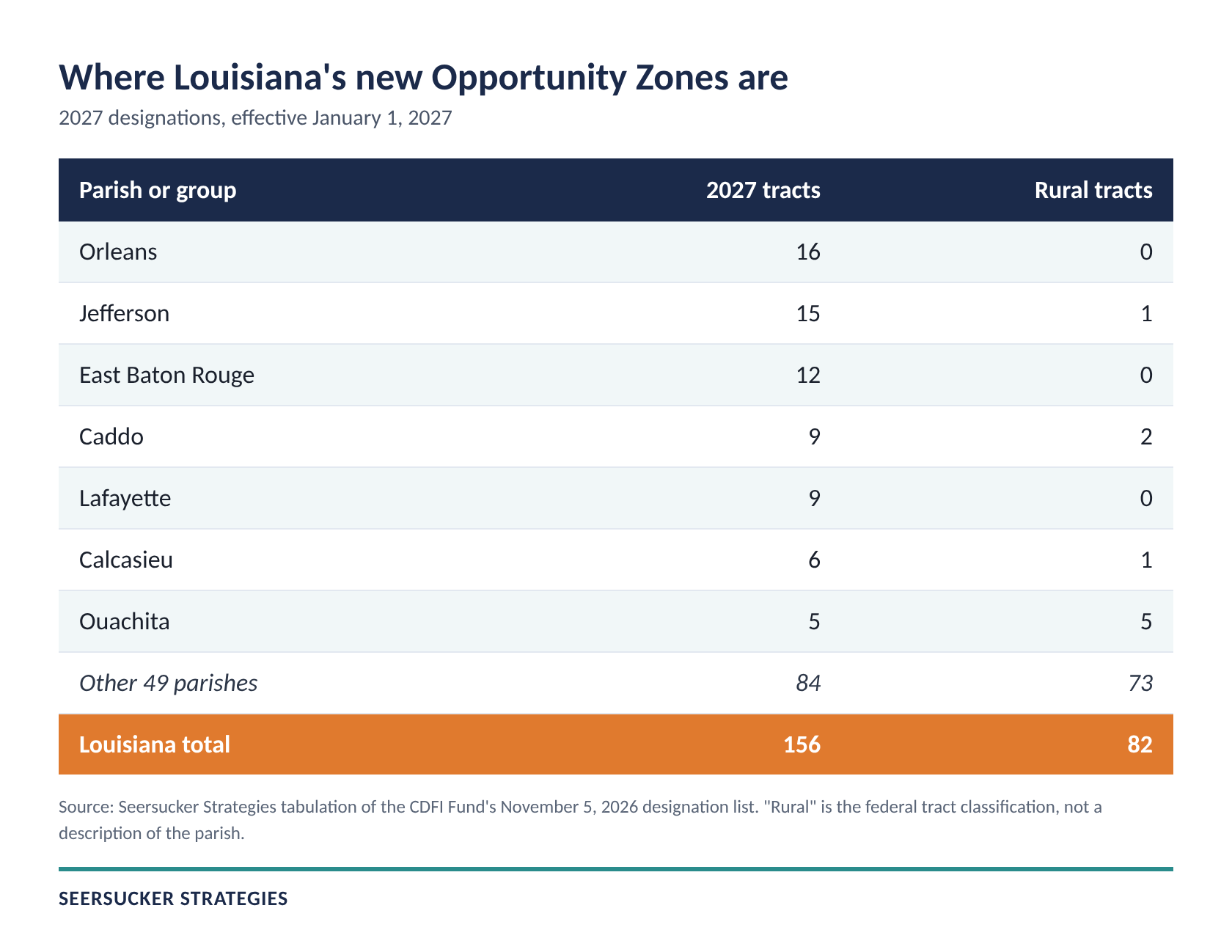
The map runs on two tracks. Seven parishes hold nearly half the tracts, almost all of them urban. The remaining 49 parishes hold 84 tracts, and 73 of those are rural. A parish’s appearance on the list does not mean every address in it qualifies; the census tract is the test, and the tract boundary is what counts.
How the 2027 incentive works
An investor rolls an eligible capital gain into a Qualified Opportunity Fund, generally within 180 days. The fund then invests in zone property or a qualifying operating business. Buying a building in a zone, lending to a zone business, or moving an office into a tract does not by itself create the investor benefit.
For investments made after December 31, 2026, tax on the original gain is deferred for five years or until an earlier sale. At the five-year mark, the investor’s basis rises by 10 percent of the deferred gain, or by 30 percent if the investment is held through a qualified rural opportunity fund. After ten years, appreciation on the fund investment can be excluded from tax.
In practice, a $1 million gain invested in 2027 and held five years would leave $900,000 of that gain taxable, or $700,000 in a qualified rural fund, assuming no earlier sale or loss in value. Those are taxable amounts, not tax bills.
The 30 percent benefit has a condition attached: the fund must hold at least 90 percent of its assets in qualifying rural property. One rural asset in a mixed portfolio does not earn it. Separately, property in an entirely rural tract faces a lower improvement threshold. An owner rehabilitating an existing building must add improvements exceeding 50 percent of its adjusted basis within 30 months, rather than the 100 percent required elsewhere.
Do not carry the old rules into a new project
Louisiana’s 150 legacy zones remain designated through 2028, but IRS Notice 2026-40 generally ties property acquired after December 31, 2026, to the new map. The exceptions are narrow. One covers working-capital plans adopted by the end of 2026, provided the business has received at least 10 percent and spent at least 5 percent of the planned capital by that date. Another covers ordinary replacement or modernization of existing property, but not expansion or a new line of business.
Gains deferred under the original program must be recognized on December 31, 2026. Eligible gains realized during 2026 may still be invested under the new rules in 2027 if the 180-day window allows. Anyone with an existing fund, a working-capital plan or a pending acquisition in a legacy tract should have counsel review it before year end.
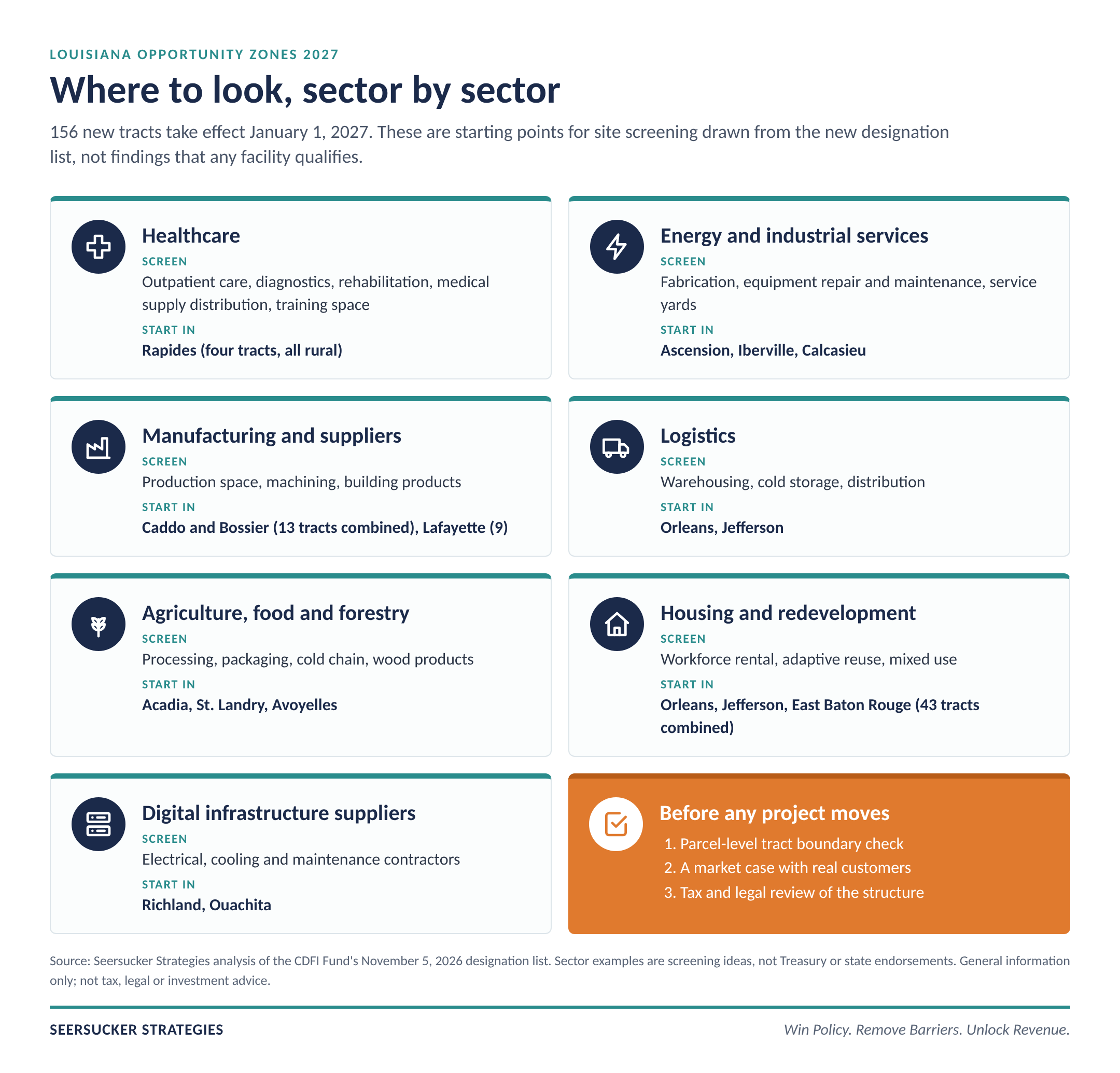
Each sector carries its own complications. A nonprofit healthcare provider cannot take fund equity directly, so any property company or joint venture needs separate legal review, including healthcare leasing and referral rules. Energy credits and other incentives have their own eligibility tests and do not stack automatically. Businesses with mobile crews or equipment fleets need care under the rules on where property is used and where income is earned. A nominal office or mailing address in a tract does not satisfy them.
Policy watch: IRS Notice 2026-55 requests comments by November 23, 2026, on unresolved implementation questions, including working-capital plans, operating businesses and the 10-year and 30-year rules. Comments go through regulations.gov under docket IRS-2026-1156. Industry groups with a concrete obstacle should consider filing.
The bigger picture
When a federal incentive is fixed to a map for ten years, and more than half of a state’s new tracts lie outside its cities, the question for Louisiana is less whether capital will look at rural parishes than whether those parishes will have projects ready when it does. That readiness is built locally, one verified site and one capable operator at a time. We are helping organizations screen sites, and we are glad to talk through a project or an obstacle you have in mind.
Sources: U.S. Treasury and IRS, IR-2026-132 (November 5, 2026); CDFI Fund, Opportunity Zones Resources and 2026 designated-zone list; Public Law 119-21, section 70421; IRS Notice 2026-40; IRS Notice 2026-55; Louisiana Economic Development, Federal Opportunity Zones. This post is general information, not tax, legal or investment advice.