

Health Policy
Healthy Blue exits Louisiana Medicaid: what IB 26-12 asks of providers before January 1
Stephen Wright · SEPTEMBER 8, 2026
LDH's Informational Bulletin 26-12 moves more than 290,000 Healthy Blue members to four remaining Medicaid plans on January 1, 2027. The exit is the headline. The deadline is October 1, which is when a provider's contracting, credentialing, and prior-authorization plan has to be in motion.
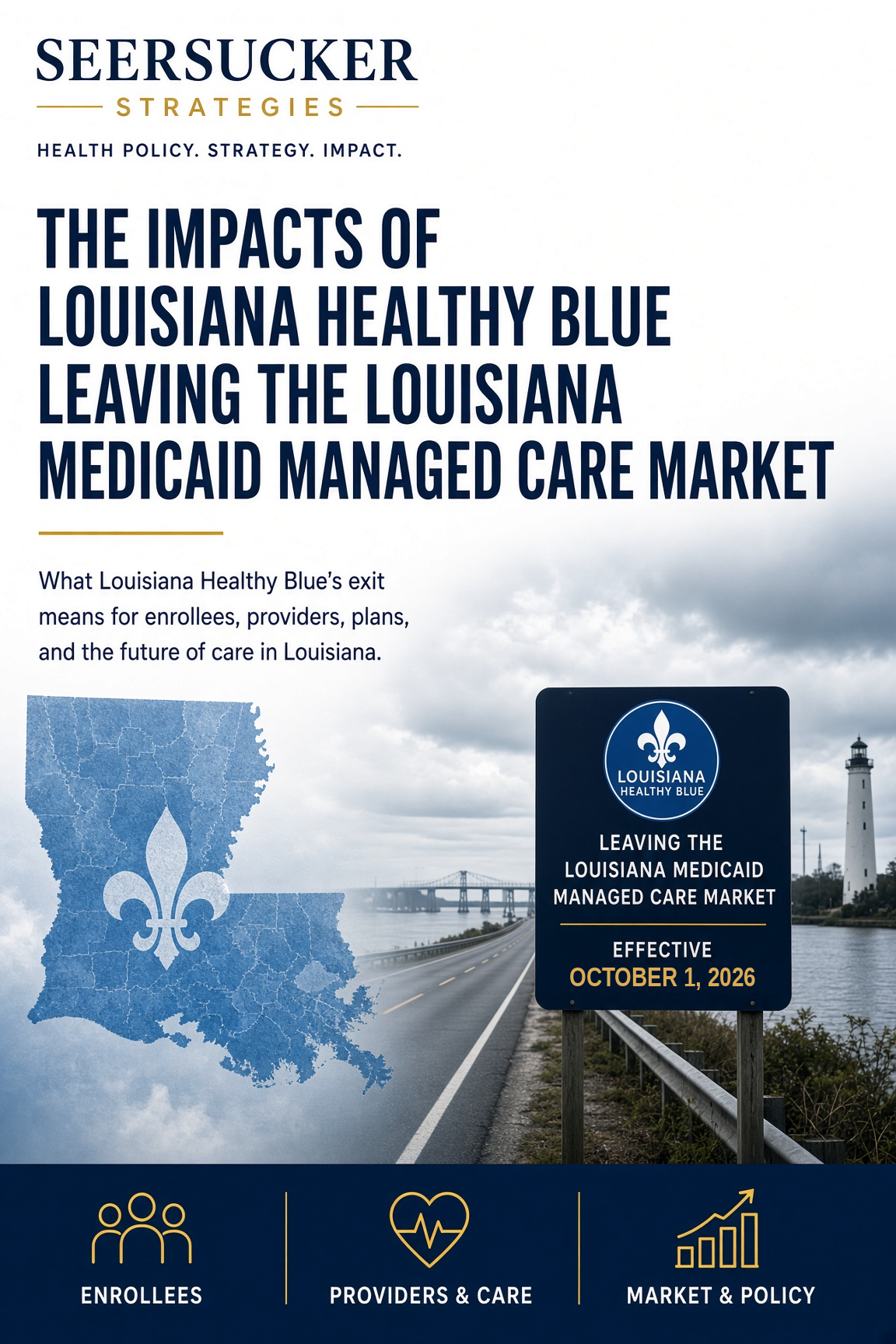
LDH's Informational Bulletin 26-12 moves more than 290,000 Healthy Blue members to four remaining Medicaid plans on January 1, 2027. The exit is the headline. The deadline is October 1, which is when a provider's contracting, credentialing, and prior-authorization plan has to be in motion.
More than 290,000 Louisiana Medicaid members will wake up on January 1, 2027 with a different health plan. LDH issued Informational Bulletin 26-12 on September 1 to explain the mechanics, and the mechanics are where this transition will be won or lost. Whether a patient keeps her prescriber, her treatment episode, and her appointment in February turns on decisions her provider makes before October 1.
Healthy Blue's managed care contract ends December 31, 2026. Beginning January 1, Louisiana Medicaid managed care runs through four plans: Aetna Better Health, AmeriHealth Caritas Louisiana, Humana Healthy Horizons in Louisiana, and Louisiana Healthcare Connections.
The dates that govern everything else
DATE WHAT HAPPENS
October 1, 2026 Provider deadline. Contracting, credentialing, and authorization transition plan for the four remaining plans has to be underway. LDH notification letters reach members the same week.
October 15 – November 16, 2026 Special enrollment period. Members choose a new MCO by phone, at myplan.healthy.la.gov, or in the Healthy Louisiana app.
November 23, 2026 MEVS reflects new MCO assignments for dates of service on or after January 1.
December 31, 2026 Healthy Blue contract ends.
January 1, 2027 New plan assignments take effect at 12:01 a.m.
June 30, 2028 Healthy Blue's provider call center stops operating.
Members who make no selection during the enrollment window are auto-assigned. LDH says the assignment logic tries to keep families in the same plan and to match members to a plan their current providers already participate in.
That second objective is where October 1 comes from. The algorithm can only route a member to a provider it can see in a network, and it runs after the enrollment window closes on November 16. Credentialing at a Medicaid MCO commonly takes sixty to ninety days. Counting backward from mid-November, a provider who has not started by October 1 will not be in the file the algorithm reads, and the patients it would have kept will be assigned somewhere else.
Seersucker take — Two dates, in order. October 1 is when the contracting and authorization work has to be underway, because everything downstream is priced off network status. November 23 is when a practice pulls eligibility and sees, member by member, where its Medicaid panel actually landed. A practice that treats January 1 as the deadline has already missed both.
Prior authorizations: sixty days, and a shorter clock than it looks
The receiving MCO must honor Healthy Blue authorizations for up to 60 days, or through the authorization's own end date, whichever comes first. Pharmacy authorizations are treated differently and are honored through their stated expiration.
Two things follow from that "whichever comes first" clause. An authorization written to expire January 20 buys twenty days, not sixty. And an authorization written through June expires on March 1 regardless. Providers are directed to submit concurrent review requests to the new MCO before the Healthy Blue authorization lapses, which means the concurrent review has to be built off a plan relationship and a clinical file that may not exist yet on the receiving side.
The bulletin says nothing about transferring care management files, case notes, or care coordinator assignments from Healthy Blue to the receiving plan. That silence is the single largest unresolved question in the document for any provider whose patients carry complex authorizations.
Where behavioral health and SUD providers are most exposed
A sixty-day authorization bridge is a comfortable cushion for an episodic outpatient service. It is a much tighter fit for a treatment episode measured in months.
Consider what the calendar does to a residential or intensive outpatient episode authorized in November under Healthy Blue. The authorization survives the plan change, but only until roughly March 1, and the concurrent review that extends it has to be filed with a plan that has none of the admission documentation, none of the ASAM level-of-care determination, and no relationship with the clinical team. If the receiving plan applies its own medical necessity criteria to a mid-episode continued-stay request, the patient's level of care can move for reasons that have nothing to do with the patient.
Opioid treatment programs sit in a different spot, and a somewhat better one. Because pharmacy authorizations run through their own expiration rather than the 60-day window, medication continuity for buprenorphine and naltrexone is on firmer footing than the counseling and case management wrapped around it. The medication and the services attached to it are governed by two different rules in the same bulletin.
Seersucker take — Behavioral health and SUD providers should pull every active authorization before October 1 and sort it by end date, not by patient. Anything expiring between January 1 and March 15 needs a concurrent review filed early with the receiving plan, with the ASAM determination and the admission record attached rather than referenced. Assume the new plan is reading the case cold, because it is.
The out-of-network rule, and what it does not do
IB 26-12 bars a receiving MCO from denying a prior authorization solely because the requesting provider is out of network. That is a real protection and it is narrower than it first reads.
The rule governs authorization. It does not set a payment rate, create a single-case agreement, confer network participation, or waive credentialing. A provider who was contracted with Healthy Blue and nobody else can obtain an authorization on January 2 and still have no contracted rate to bill against. The bulletin's own remedy is blunt: providers contracted only with Healthy Blue should contract with the remaining four plans.
Credentialing at four MCOs is not a December task. It has to be underway before October 1, which makes it a September task, and September is nearly gone.
Specialty practices and the panel arithmetic
For dermatology, psychiatry, speech-language pathology, and other specialty practices, the exposure is less about authorization continuity and more about arithmetic. Healthy Blue's members are about to be distributed across four plans on a schedule the practice does not control. A practice contracted with two of the four keeps roughly half its former Healthy Blue panel, and finds out which half in late November.
Referral relationships redistribute the same way and less visibly. A specialist can hold contracts with all four plans and still lose volume because a referring primary care group does not.
Seersucker take — The decision on whether to pursue a fourth contract belongs to September, not December, because a contract started in December will not be live for the January panel. Run the December analysis off the November 23 MEVS refresh to confirm what the decision produced, not to make it. A practice that discovers the gap in February is reading it off claims denials.
Hospital and facility billing across the December 31 line
For a member hospitalized on December 31, the remainder of the stay reverts to the receiving MCO at 12:01 a.m. on January 1. The stay gets split-billed, and the bulletin sets out the arithmetic.
Value Code 80 must be present and greater than zero. Where patient status is 30, or the discharge date equals the admit date, the statement-through date minus the statement-from date plus one must equal billed days, calculated as Value Code 80 plus Value Code 81. Where patient status is not 30 and discharge does not equal admit, the same equation runs without the plus one.
Healthy Blue continues to process claims under its 365-day timely filing allowance and keeps a provider call center running through June 30, 2028. The runway is generous. The billing edits are not, and a claim that fails the day-count math will reject on both sides of the split.
The bigger picture: six plans to four in under three years
Louisiana's managed care market has contracted twice in quick succession. UnitedHealthcare left the program effective April 1, 2026, following a dispute involving Attorney General Liz Murrill and its parent company's pharmacy benefit operations. Healthy Blue, a plan operated by Elevance Health with Blue Cross and Blue Shield of Louisiana, follows nine months later. The Louisiana Illuminator reports that Elevance told investors in July it intended to leave several state Medicaid markets over the following twelve to eighteen months, which places Louisiana inside a national retrenchment rather than a Louisiana-specific quarrel.
The Illuminator also puts the enrollment trend alongside the plan count: six plans covering more than 1.6 million people at the start of 2024, and roughly 1.2 million across five plans today. Both numbers are moving in the same direction at once.
Fewer plans is not self-evidently worse. Senator Patrick McMath, who chairs Senate Health and Welfare, has said four plans is a more workable number for a state Louisiana's size, and the administrative case for that is straightforward: every additional MCO multiplies credentialing files, authorization portals, appeal timelines, and billing edits a practice has to maintain. A small psychiatric group in Alexandria feels the difference between four plans and six more acutely than any actuarial table will show.
The offsetting cost is leverage. Fewer buyers in a market means fewer places to go when a rate negotiation stalls or a network decision goes against a provider, and it concentrates a larger share of the state's Medicaid population inside each remaining plan's utilization management. Louisiana Healthcare Connections, already the largest plan at roughly 364,000 members before this transition, will absorb a further share of Healthy Blue's book. Whether that consolidation produces a simpler system or a stiffer one depends less on the plan count than on how the state writes and enforces the next round of contracts, and that is a policy question the Legislature and LDH will take up well before the 2027 session.
What we do
Seersucker Strategies works with behavioral health and SUD providers, specialty practices, and healthcare associations on exactly this class of problem. For the Healthy Blue transition, that means every hospital, physician group, FQHC, and behavioral-health provider in the state needs a contracting, credentialing, and prior-auth transition plan for the four remaining plans, and needs it before October 1. Reach out to us if you need assistance.
The transition is administrative. Its consequences, for a patient thirty days into a treatment episode, are not. Providers who finish the authorization inventory and start the contracting work before October 1 will spend January treating patients; those who wait will spend it on hold.
Sources: LDH Informational Bulletin 26-12 (September 1, 2026); LDH news release, "Louisiana Department of Health announces transition for Medicaid Healthy Blue members ahead of contract's conclusion"; Louisiana Healthcare Connections provider notice on IB 26-12; Louisiana Illuminator, September 1, 2026; LDH "Changes to Medicaid Health Plans in 2026."