
Health Policy
Mississippi's Opioid Settlement Portal Opens Today. The Rules Are New, and So Is the Scorer.
Stephen Wright · AUGUST 31, 2026
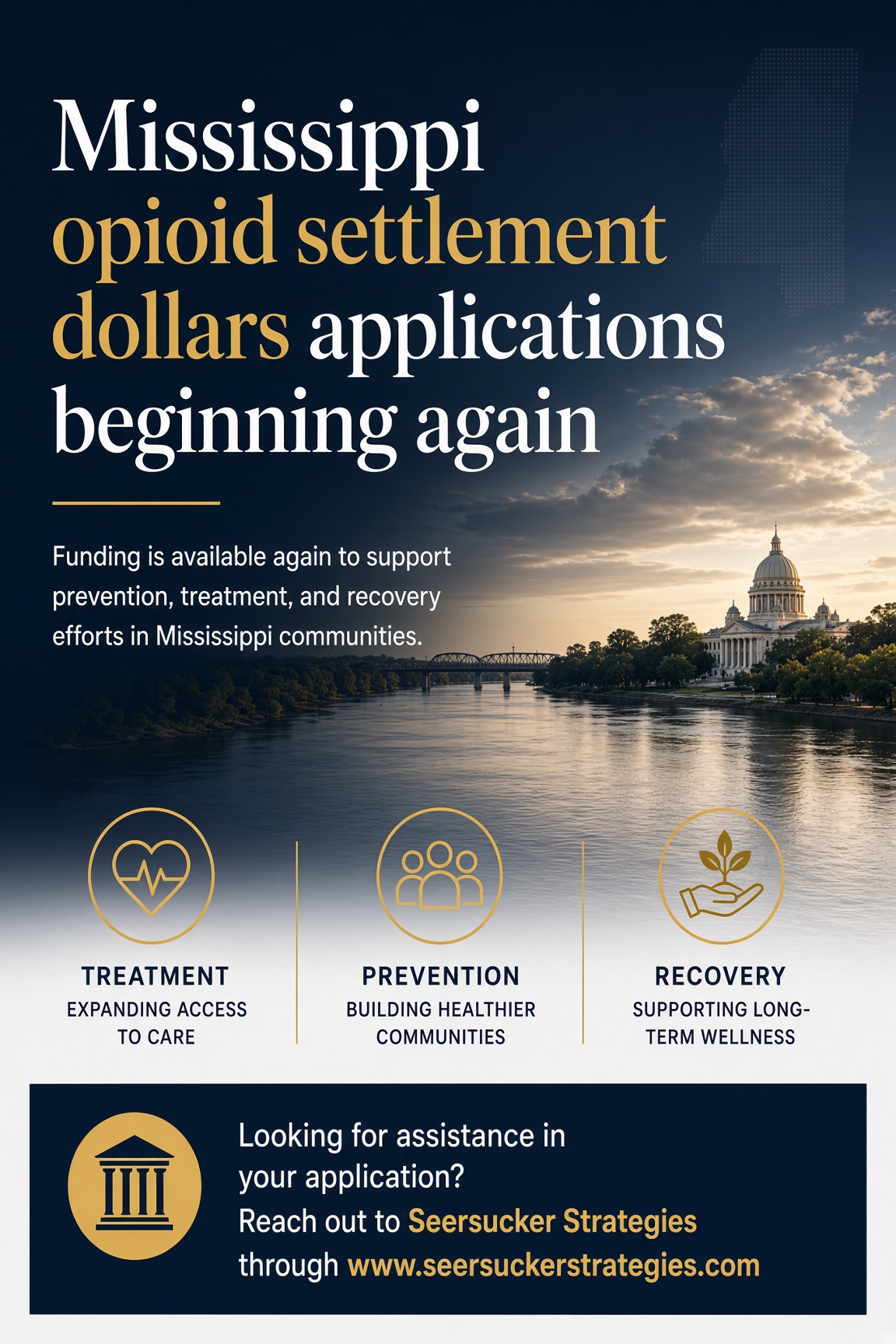
Mississippi's second competitive round of opioid settlement grants opens August 31 and closes October 5 — with an outside firm scoring against a published 100-point rubric, conflict-of-interest attestations from reviewers, and a Legislature that can now change the council's numbers before it appropriates.
Mississippi's second competitive round of opioid settlement grants opens August 31 and closes October 5 — with an outside firm scoring against a published 100-point rubric, conflict-of-interest attestations from reviewers, and a Legislature that can now change the council's numbers before it appropriates.
Mississippi's second competitive round of opioid settlement grants opens August 31 and closes October 5. Applicants face a rebuilt process: an outside firm scoring against a published 100-point rubric, conflict-of-interest attestations from reviewers, and a Legislature that can now change the council's numbers before it appropriates.
Six weeks to apply, ten months to spend
Mississippi expects roughly $430 million from settlements with opioid manufacturers, distributors, and pharmacy chains, paid out through 2040. Of that, the state-controlled share running through the Opioid Settlement Fund Advisory Council is about $300 million. The Legislature appropriated roughly $51 million during the 2026 session, the first cycle in which any meaningful sum moved.
The calendar for this round is short at the front and long at the back.
MILESTONE DATE
Application portal opens August 31, 2026
Applicant webinar (Steadman Group) September 15, 2026, 2:00–3:00 p.m. CT
Applicant webinar (Steadman Group) September 23, 2026, 1:00–2:00 p.m. CT
Applications due October 5, 2026, 5:00 p.m. CT
Council review and recommendations Late November 2026 (tentative)
Recommendations to the Legislature December 4, 2026
Project period July 1, 2027 – June 30, 2028
An organization that submits in early October will not spend a settlement dollar until the following summer, and only if the Legislature appropriates it. That gap between application and cash matters more than most applicants budget for.
What the solicitation requires
Eligible applicants include 501(c)(3) nonprofits, counties and municipalities, faith-based organizations, healthcare providers and systems, educational institutions, Mississippi-incorporated for-profits, and national organizations running Mississippi-specific programs. All must be incorporated or recognized in the state and must spend the money on Mississippi residents.
Every non-administrative budget line has to map to Exhibit E of the national settlement agreements — the approved list of opioid remediation uses — and to one of eight strategy pillars the portal names, from prevention and early intervention through enforcement and data-driven policy. Administrative costs are capped at 10 percent of the award.
Payment turns on a single threshold. Projects at or below $50,000 can be paid in a lump sum. Everything larger is reimbursement-based: the grantee fronts the cost and recovers it after filing a report the state accepts as accurate and complete. Awardees file monthly or quarterly reports, document every expenditure, and retain records for five years after the award period ends.
Seersucker Analysis — The $50,000 line is the most consequential number in the solicitation for a small provider. Above it, you are extending credit to the state on a monthly reimbursement cycle, and your ability to do that is itself a scored criterion under the financial-stability priority. Organizations without the balance sheet to carry two months of program cost should either size the ask below the threshold or partner with an entity that can carry it.
Why the process was rebuilt
The redesign has a traceable cause. The Legislature created the advisory council in 2025 under SB 2767, codified at Miss. Code Ann. § 41-153-1, to recommend how the Opioid Settlement Fund should be spent. In September 2025, Mississippi Today reported that of roughly $124 million the state had received by mid-2025, less than $1 million had gone to addressing the epidemic; that 15 percent of settlement dollars had been routed to local governments with no restrictions and no reporting obligation; and that the council's first round of recommendations favored organizations affiliated with its own members.
The 2026 session produced SB 2726 in response. The final bill required the Attorney General's Office to contract with a third-party consultant within two months of enactment, tightened rules barring council members from influencing evaluations of applications they are connected to, and gave lawmakers authority to amend recommended award amounts rather than simply accept or reject them. A House provision by Rep. Sam Creekmore that would have required all 147 municipalities and counties receiving roughly $63 million to spend it on overdose prevention and public health did not survive negotiations. Local discretion over that share remains as it was.
The consultant is the Steadman Group, a Denver-based behavioral health firm selected from three submissions under a roughly $350,000 engagement against a $400,000 appropriation. Steadman runs the portal, provides technical assistance, standardizes scoring, and evaluates how awarded funds are used. It has done comparable work for South Dakota and Oklahoma.
What happened next is the part applicants should study. Lawmakers distributed close to $60 million in ways that rarely matched the council's recommendations, including funding for organizations the council had never scored. Governor Tate Reeves then partially vetoed $1.55 million across three groups, citing the absence of council vetting, although all three had submitted applications.
Seersucker Analysis — There are two audiences for this application, and they read differently. Steadman scores the rubric. The Legislature appropriates, and it now has express authority to change the number. A strong technical application that no member of the Jackson delegation has ever heard of is a weaker position than most applicants assume. Build the scored file and the legislative record in parallel, starting before December 4.
What the rubric rewards
Applications are scored out of 100 points across six areas: abatement impact, proposal narrative, geographic area and population served, financial stability, matching funds, and sustainability. Behind those sit eleven published priorities — among them the size of the population served, how long the organization has delivered similar services, demographic variety with a focus on underserved communities, alignment with the settlement's core strategies, and potential to close identified service gaps.
Read that list and the structural bias is visible. Tenure and financial stability reward incumbents. Underserved-population focus and gap-closing potential cut the other way, and they are where a smaller or rural applicant can outscore a larger one. Matching funds are not required to apply, but capacity to match is scored, and an in-kind match documented at fair value counts for organizations that cannot write a check.
Louisiana is running the opposite experiment
Two Gulf South states received settlement money on the same schedule and built nearly opposite machinery to spend it.
Mississippi centralized: one fund, one council, one scored competition, one appropriation, and a growing paper trail. Louisiana decentralized. Under the state-local memorandum of understanding, 80 percent of settlement dollars flow to parishes and municipalities and 20 percent to sheriffs — the largest law enforcement carve-out of any state — with no competitive state pot at all. The Louisiana Opioid Abatement Task Force advises on allocation but cannot compel anything, a limitation the Legislative Auditor summarized in 2025 by noting the task force has no teeth to enforce its recommendations.
What that produces showed up in reporting published four days before Mississippi's portal opened. Of $8.1 million in sheriff expenditures KFF Health News reviewed across 38 parishes, outside reviewers judged $5.4 million inappropriate, and $4.7 million matched items other states place on unallowable lists: surveillance cameras, drones, vehicles, evidence safes. Some sheriffs funded jail-based treatment and overdose response training. None are required to report their spending to the public.
Neither design has yet proven it moves overdose numbers. But the trade is legible. Mississippi imposes cost on applicants, slow timelines, and a political layer between the score and the check, and gets back a record someone can audit. Louisiana moves money quickly to officials who know their parishes, which leaves gaps in what a taxpayer can inspect. Either way, the funder's structure is the thing to plan around, and Mississippi's now rewards organizations that can document outcomes, carry cost between reimbursements, and make the case in two rooms rather than one.
The portal is open. Read the rubric before writing the narrative, and start the legislative conversation before the council votes in November. Need help developing your application? Reach out to us now.
Seersucker Strategies advises behavioral health and substance use disorder providers, healthcare associations, and public agencies across the Gulf South on grant strategy, legislative positioning, and regulatory compliance.