

Health Policy
Heat Is Infrastructure: Reading Louisiana's September Forecast Like a Public Health Document
Stephen Wright · SEPTEMBER 21, 2026
Late September in Louisiana still brings near-record highs and heat indices above 105. Here are the warning signs pediatricians and dermatologists want families to know, and the state and federal rules that decide when heat protections for homes, school practices, and outdoor workers actually take effect.
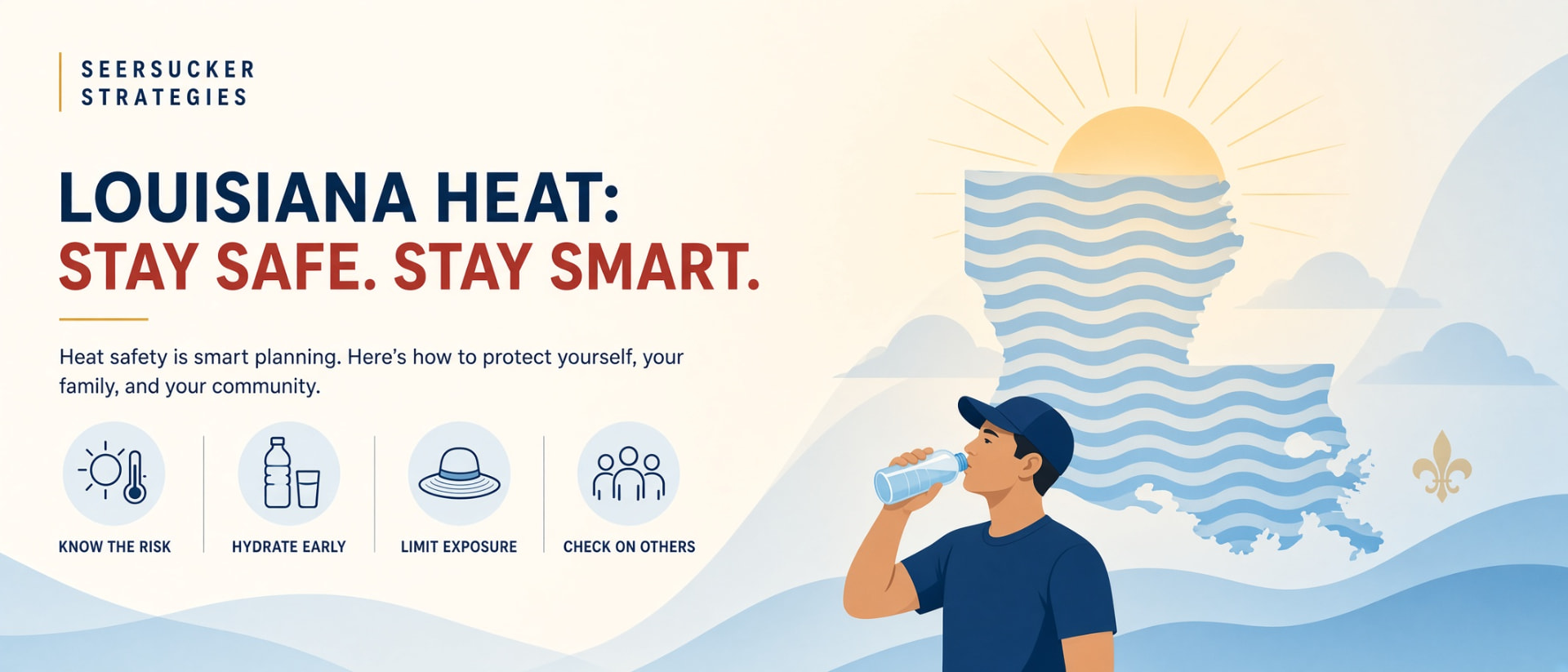
Late September in Louisiana still brings near-record highs and heat indices above 105. Here are the warning signs pediatricians and dermatologists want families to know, and the state and federal rules that decide when heat protections for homes, school practices, and outdoor workers actually take effect.
On Monday, September 21, the National Weather Service office for New Orleans and Baton Rouge forecast highs in the low to mid 90s across southeast Louisiana, with upper 90s possible near Baton Rouge and peak heat index values in the mid to upper 100s. Forecasters expected highs to run near record levels through midweek. As of September 3, the Louisiana Department of Health had counted 18 heat-related deaths and 4,232 heat-related emergency department visits statewide this year.
Most people read those two sets of numbers in different places, one on a phone's weather app and the other on a state dashboard. They belong on the same page. Heat is a load that our homes, schools, workplaces, and power grid are built to carry, some better than others. When a forecast crosses certain lines, rules switch on: a utility may not cut off a household's power, and a football practice must slow down or stop. When the forecast falls just short of those lines, the same heat arrives with fewer protections attached.
Seersucker Strategies represents the Louisiana Chapter of the American Academy of Pediatrics and the Louisiana Dermatological Society. This post pairs the practical guidance their national organizations publish for families with the policy thresholds that govern Louisiana's response to heat.
Louisiana's heat toll, by the numbers
202388 heat-related deaths and 6,142 heat-related emergency department visits. Louisiana's hottest summer on record; statewide highs above 95°F on 56 days.
202531 heat-related deaths and 1,574 heat-related emergency department visits, per full-year totals reported by the Louisiana Department of Health.
2026 (through Sept. 3)18 heat-related deaths and 4,232 heat-related emergency department visits. 200 of those visits were in East Baton Rouge Parish.
This year's deaths were concentrated early in the season, with 10 in June, five in July, and three in August. Through July, six of the seven people who had died were 65 or older. Children rarely appear in the death counts. They do appear in emergency rooms, at practice fields, and in the back seats of parked cars, which is where prevention does its work.
Warning signs every parent should know
Heat illness moves along a spectrum. Heat exhaustion is the body struggling to shed heat; heat stroke is the body failing to. The first is treatable at home if caught early. The second is a medical emergency.
Heat exhaustionWhat you may see: heavy sweating; cool, pale, clammy skin; headache; dizziness; nausea or vomiting; muscle cramps; weakness; fast, weak pulse. What to do: move to shade or air conditioning, loosen or remove extra clothing and gear, apply cool wet cloths, and have the child sip water. Get medical care if they vomit, get worse, or are not better within an hour.
Heat strokeWhat you may see: body temperature of 103°F or higher; hot skin that may be dry or damp; confusion, slurred speech, or unusual behavior; fainting; seizures; fast, strong pulse. What to do: call 911. Start cooling immediately; for an athlete, a cold-water tub is the fastest method. Do not give fluids to a child who is confused or not fully alert.
Young children cannot tell you they are overheating. In infants and toddlers, watch for fewer wet diapers, unusual fussiness or sleepiness, and refusing to drink. Teenagers present the opposite problem: they can tell you but often won't, especially in front of a coach or teammates. Confusion in a teenager at practice should be treated as heat stroke until proven otherwise.
A few habits prevent most of what ends in the emergency room:
Drink water before outdoor activity and at regular breaks, without waiting for thirst.
Schedule outdoor play and yard work for morning or evening; the late-afternoon sun in September is still close to its summer strength.
Give a child who is new to a sport, or back from a long break, one to two weeks to build up to full workouts. Louisiana law defines this acclimatization period as seven to fourteen days.
Dress children in light-colored, loose clothing, and take helmets and pads off during rest breaks.
Never leave a child in a parked car, even with the windows cracked. A closed car can heat by about 20 degrees in 10 minutes.
Skin is the first thing the sun reaches
Sunburn does not stop after Labor Day, and in south Louisiana the UV index, not the thermometer, is the number that predicts it. The American Academy of Dermatology recommends a broad-spectrum, water-resistant sunscreen with SPF 30 or higher, applied about 15 minutes before going outside and reapplied every two hours, or sooner after swimming or heavy sweating. Hats with a brim, sunglasses, and tightly woven clothing do much of the same work without needing reapplication.
Babies under six months should be kept out of direct sun entirely, in shade and lightweight clothing that covers the arms and legs. When shade is not available, the American Academy of Pediatrics says a small amount of sunscreen (SPF 15 or higher) on exposed areas such as the face and backs of the hands is acceptable.
Three other skin problems show up more often in heat like this week's:
Heat rash comes first: clusters of small red bumps or blisters in skin folds and under clothing, caused by blocked sweat ducts. Cooling off and loose, breathable clothing usually clear it within days. Call the doctor if the bumps fill with pus, spread, or come with a fever.
Medication-related sunburn is the second. Some antibiotics and acne treatments make skin burn faster and more severely. If your child or teenager started a new prescription this year, ask whether it increases sun sensitivity.
The third is a bad burn. Blistering over a large area, or a sunburn accompanied by fever, chills, or vomiting, calls for medical attention the same day.
Three protections, three thresholds
Louisiana families are covered by several heat protections, each written by a different body and each triggered by a different measurement. Parents rarely see how they work, so the list below sets them side by side.
No residential power shutoffsLegal source: LPSC General Order R-29706 (2007). Trigger: the National Weather Service issues a heat advisory for the parish. Limit: gas utilities are exempt unless the customer uses gas to cool the home.
Heat policy for school athleticsLegal source: R.S. 40:1087.1, as amended by Act 113 of 2022 (HB 197, Rep. Turner), and BESE Bulletin 135. Trigger: wet bulb globe temperature (WBGT) readings under ACSM/NATA guidelines. Limit: football jamborees and regular season games are exempt from the statute.
Heat standard for workersLegal source: federal OSHA. Trigger: no specific heat standard is in effect; the proposed rule would trigger at heat indices of 80°F and 90°F. Limit: the proposal was published in August 2024 and is not finalized; enforcement relies on OSHA's General Duty Clause.
The power shutoff rule and the day that falls short
The Public Service Commission's rule is simple on paper. On a day when the nearest National Weather Service office issues a heat advisory for a parish, an electric utility may not disconnect a residential customer in that parish for nonpayment. The Commission adopted the heat advisory as its benchmark in 2007 and has not changed the order since; it was cited again at the Commission's December 2025 meeting.
Follow the rule forward and a consequence appears. The protection depends on whether a heat advisory is issued, and advisory criteria are set by the Weather Service, not by the Commission. The 2007 order's footnote described an advisory as beginning at a heat index of 105°F. In Sunday's forecast discussion, the New Orleans office put its local advisory threshold at 108°F and expected heat indices as high as about 106. On a day like that, the heat is dangerous by any clinical measure, no advisory is issued, and the shutoff protection does not apply.
A fixed, external trigger has real advantages. Utilities and customers know in advance when the rule applies, and the Commission does not have to rule on the weather day by day. The cost falls at the margin, on the household that receives a disconnection notice during a stretch of 104- to 107-degree days. For a family with an infant, a child with asthma, or a grandparent at home, air conditioning functions as medical equipment.
School practices: a statute with a scoreboard exception
Act 113 of 2022 requires every school in interscholastic athletics to follow heat acclimatization and WBGT practices based on American College of Sports Medicine and National Athletic Trainers' Association guidance, wherever practice happens outside a climate-controlled facility. BESE's Bulletin 135 fills in the details: rest and hydration ratios that tighten as WBGT rises, helmets off during breaks, shaded rest areas, and cold-water immersion tubs on hand once WBGT passes 85. WBGT is a better measure than the heat index because it accounts for direct sun and wind, which is exactly what a football field in September adds.
The statute exempts football jamborees and regular season games. Game-day safety therefore rests on LHSAA rules and each school's own emergency plan. Parents can ask their school's athletic trainer one direct question: what WBGT reading cancels or modifies a Friday night game, and who makes the call?
The worker in the family
Many Louisiana children have a parent who works outdoors, and many teenagers take outdoor jobs themselves. Louisiana has no state heat standard for workers, and the federal proposal remains unfinished. OSHA published its proposed rule in August 2024; as of August 2026 no final standard exists. OSHA issued a revised heat enforcement program on April 10, 2026, and can still cite employers under its General Duty Clause.
The Department of Health's own investigation of a 2019 sugarcane worker's death shows why the first days on a job matter most. He began work on a Friday and collapsed the following Monday morning, when the WBGT already exceeded 90 before 9 a.m. The lesson is the same one Louisiana wrote into law for student athletes: bodies need a week or two to adapt, and the first week is when heat kills. The proposed federal rule would require an acclimatization plan for new and returning workers; until it or something like it takes effect, families should ask employers directly how new hires are brought up to full workloads.
The grid carries the same heat
Every protection above assumes the power stays on. That assumption is tested on days like this one. On September 3, the Midcontinent Independent System Operator, which runs the grid serving most of Louisiana, forecast peak demand near 121 gigawatts against an all-time record of 127.1. During the July heat wave, the grid set a record for imported power, averaging more than 17,000 megawatts in the 8 p.m. hour, after solar output faded and air conditioners were still running.
Evening is the tightest hour for the grid and one of the hottest hours inside a home without power. Decisions about how much generation to build, how to share power with neighboring regions, and which customers are asked to cut back first are made at the Public Service Commission and at the regional grid operator. Those forums rarely hear from pediatricians. They should, because the patients most harmed by a summer outage are the ones least able to leave a hot house.
The bigger picture
When summers run longer and hotter than the ones our rules were written for, and when each protection waits on its own threshold set by a different agency, the risk lies less in any single rule than in the days that fall between them. A forecast, a WBGT meter at a practice field, a disconnection order, and a regional grid plan are all pieces of the same system, and Louisiana families live inside all of them at once.
For families, this week's heat means water, shade, sunscreen, and a watchful eye on the youngest and oldest members of the household. For Louisiana's policymakers, it is a reminder that heat protections work only if their triggers match the heat Louisianans actually experience. Seersucker works with healthcare and energy clients on both sides of that equation, and we will keep tracking the rules as they change.
Sources: National Weather Service New Orleans/Baton Rouge, Area Forecast Discussion (Sept. 20, 2026); Louisiana Department of Health, Heat-Related Illness Dashboard and releases (2023–2026), as reported by KLFY, WAFB, and LDH; Louisiana Public Service Commission, General Order R-29706 (Second Amended, Oct. 5, 2007) and Dec. 17, 2025 meeting minutes; La. R.S. 40:1087.1 and Act 113 of 2022 (HB 197); BESE Bulletin 135, §507; Congressional Research Service, IN11701 (Aug. 18, 2026); Beveridge & Diamond, OSHA revised heat NEP (April 2026); LDH Louisiana FACE Program, Report LA202401; Grid Strategies, MISO heat wave imports (July 2026); Insurance Journal, MISO peak demand (Sept. 3, 2026); American Academy of Pediatrics (HealthyChildren.org); American Academy of Dermatology; CDC, Heat-Related Illnesses.