

Health Policy
Louisiana's Medicaid Reentry Waiver: The 60-Day Bridge and How It Compares
Stephen Wright · OCTOBER 14, 2026
CMS has approved Louisiana's Section 1115 reentry demonstration, which lets Medicaid pay for up to 60 days of care before release from state prisons and up to 13 parish jails. This brief covers how the program works, how it compares with the four other jurisdictions approved alongside it, and what behavioral health and SUD providers should know.
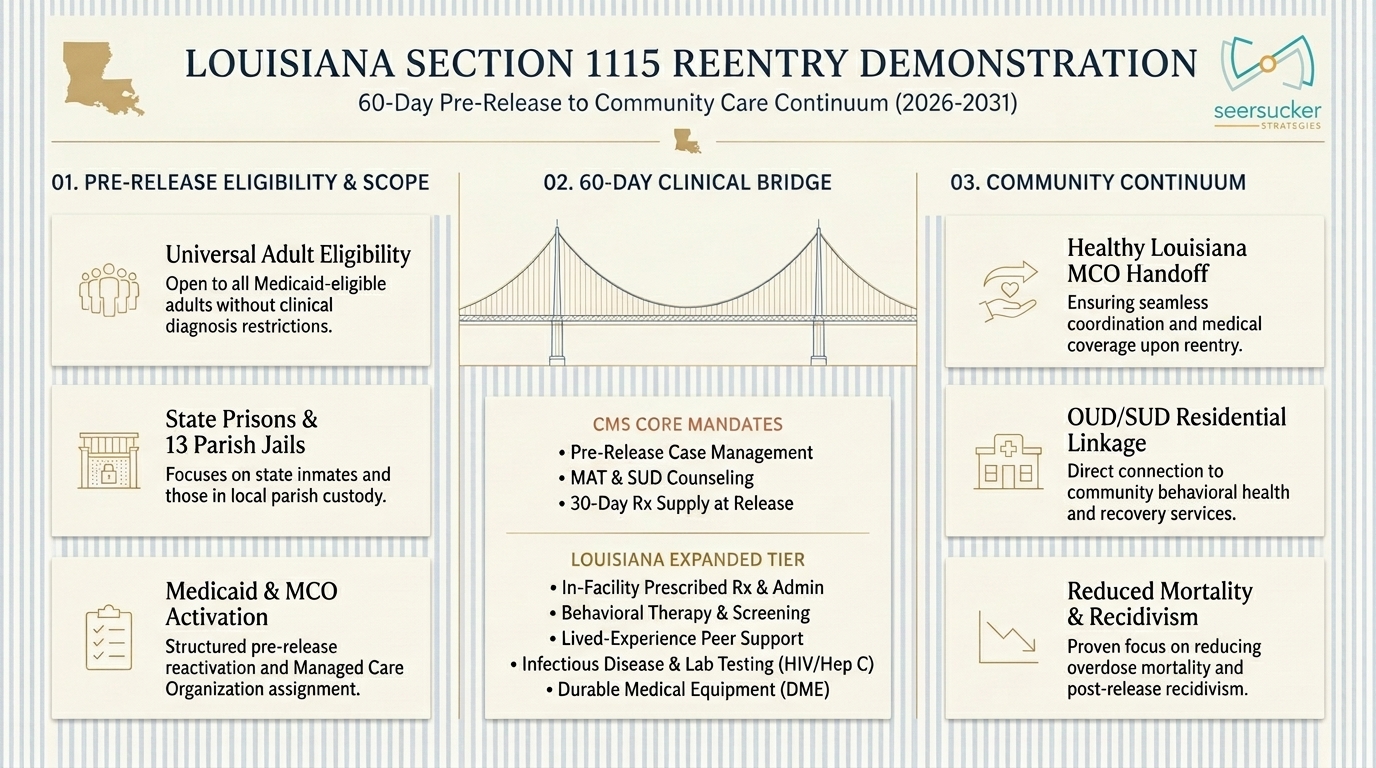
For up to 60 days before a person leaves a participating Louisiana prison or parish jail, Medicaid will now pay for case management, addiction medication, counseling, and several other services that federal law has long kept it from covering behind the walls. CMS approved the Louisiana Reentry Demonstration on September 23, 2026. The demonstration runs from October 1, 2026 through September 30, 2031, and the Louisiana Department of Health announced it on Friday, October 9.
The change matters because of the "inmate exclusion." That provision of the Social Security Act bars federal Medicaid payment for most care delivered to incarcerated people. Coverage is suspended at entry rather than terminated, but the bills belong to the jail or prison until the day of release. A Section 1115 demonstration carves out a limited exception. LDH applied on September 27, 2024 for a 90-day window, and CMS approved 60.
What Louisiana's waiver does
Who qualifies. Anyone incarcerated in a participating facility who has been determined eligible for Medicaid or CHIP and has an expected release date within 60 days. The person may be pre- or post-adjudication. No diagnosis is required. Facilities must also offer Medicaid application help to everyone in custody, so that people who arrive uninsured can enroll in time to receive the full window.
Where. Rollout begins at Elayn Hunt Correctional Center in St. Gabriel in early 2027. It then moves to the other state prisons operated by the Department of Public Safety and Corrections and to as many as 13 parish jails, each admitted only after LDH finds it ready. Youth correctional facilities are not part of Louisiana's demonstration. Facilities that qualify as institutions for mental diseases are excluded by rule.
What is covered. The approved package goes beyond the federal minimum of case management, MAT, and a 30-day medication supply at release. It includes:
case management addressing physical health, behavioral health, and social needs
MAT for all substance use disorders, with counseling or behavioral therapy
practitioner visits, including mental health and SUD treatment, therapy, and counseling
prescribed drugs and medication administration during the 60-day window
medical equipment and supplies
peer support services
laboratory services, including infectious disease testing
a 30-day supply of prescription and over-the-counter medications in hand at release
How it is delivered. Services will run through Healthy Louisiana managed care. LDH will set out the details in its implementation plan. Providers may be community-based or facility-based, must be enrolled in Medicaid, and may deliver care in person or by telehealth where the facility supports it. Case managers must coordinate with the community providers who will see the person after release.
The September cohort: five approvals under one set of rules
Louisiana was one of five jurisdictions CMS approved in late September, all effective October 1. Louisiana, Minnesota, and Nevada received new demonstrations. The District of Columbia and Maine received renewals of existing demonstrations with reentry authority added. These are the first reentry approvals under the current Administration. With them, 22 states and D.C. now hold reentry authority, according to Manatt Health's count. The Louisiana Illuminator, reporting on LDH's announcement, put the number of other states already operating programs at 18.
Approval typeLouisiana: New · District of Columbia: Renewal · Maine: Renewal · Minnesota: New · Nevada: New
Adult pre-release windowLouisiana: 60 days · District of Columbia: 60 days · Maine: 60 days · Minnesota: 60 days · Nevada: 60 days
Youth facilitiesLouisiana: Not included · District of Columbia: Included (90 days) · Maine: Included (90 days) · Minnesota: Not included · Nevada: Included (90 days)
Adult eligibilityLouisiana: All Medicaid/CHIP-eligible · District of Columbia: All Medicaid-eligible · Maine: All Medicaid-eligible · Minnesota: Clinical criteria required · Nevada: Clinical criteria required
Adult settingsLouisiana: State prisons, up to 13 parish jails · District of Columbia: Jails · Maine: Prisons, jails · Minnesota: Prisons, jails, adult tribal facilities · Nevada: Prisons, jails
Practitioner visits incl. MH/SUD therapyLouisiana: Yes · District of Columbia: Yes · Maine: Clinical consultation services · Minnesota: Yes · Nevada: Yes
Prescribed drugs during windowLouisiana: Yes · District of Columbia: Yes · Maine: Not listed · Minnesota: Yes · Nevada: Yes
Peer supportLouisiana: Yes · District of Columbia: Yes · Maine: Not listed · Minnesota: Yes · Nevada: Yes
Lab servicesLouisiana: Yes, incl. infectious disease · District of Columbia: Lab and radiology · Maine: Not listed · Minnesota: Not listed · Nevada: Lab and radiology
Medical equipment and suppliesLouisiana: Yes · District of Columbia: Not listed · Maine: Not listed · Minnesota: Not listed · Nevada: Not listed
Other added servicesDistrict of Columbia: BH consultation (youth) · Maine: Hepatitis C and HIV treatment; family planning · Minnesota: Family planning · Nevada: HIV treatment; community health workers
Start-up (transitional) fundingLouisiana: Not approved · District of Columbia: Not approved · Maine: Not approved · Minnesota: Not approved · Nevada: Not approved
"Not listed" means the service does not appear among the covered pre-release services in that jurisdiction's CMS approval letter. Minnesota requires a mental illness, SUD, chronic or significant clinical condition, or pregnancy/postpartum status. Nevada's adult list is similar and also includes intellectual or developmental disability, traumatic brain injury, and HIV; Nevada applies no clinical criteria to people under 21 or former foster youth under 26. Where youth facilities are not included, eligible juveniles still receive the 30-day pre-release screening, diagnostic, and case management services federal law requires.
The comparison shows two real design choices. The first is eligibility. Louisiana, D.C., and Maine open pre-release services to every eligible person in a participating facility. Minnesota and Nevada screen adults for qualifying conditions first, which narrows the population and adds a clinical step inside the facility. The second is the benefit package. Louisiana is the only one of the five to cover medical equipment and supplies. Maine took a different route, leaving peer support and in-window prescriptions off its list while adding hepatitis C and HIV treatment.
Three federal changes that shaped Louisiana's terms
Alongside the approvals, CMS released new reentry FAQs. Three changes set this cohort apart from the 2023–2024 approvals.
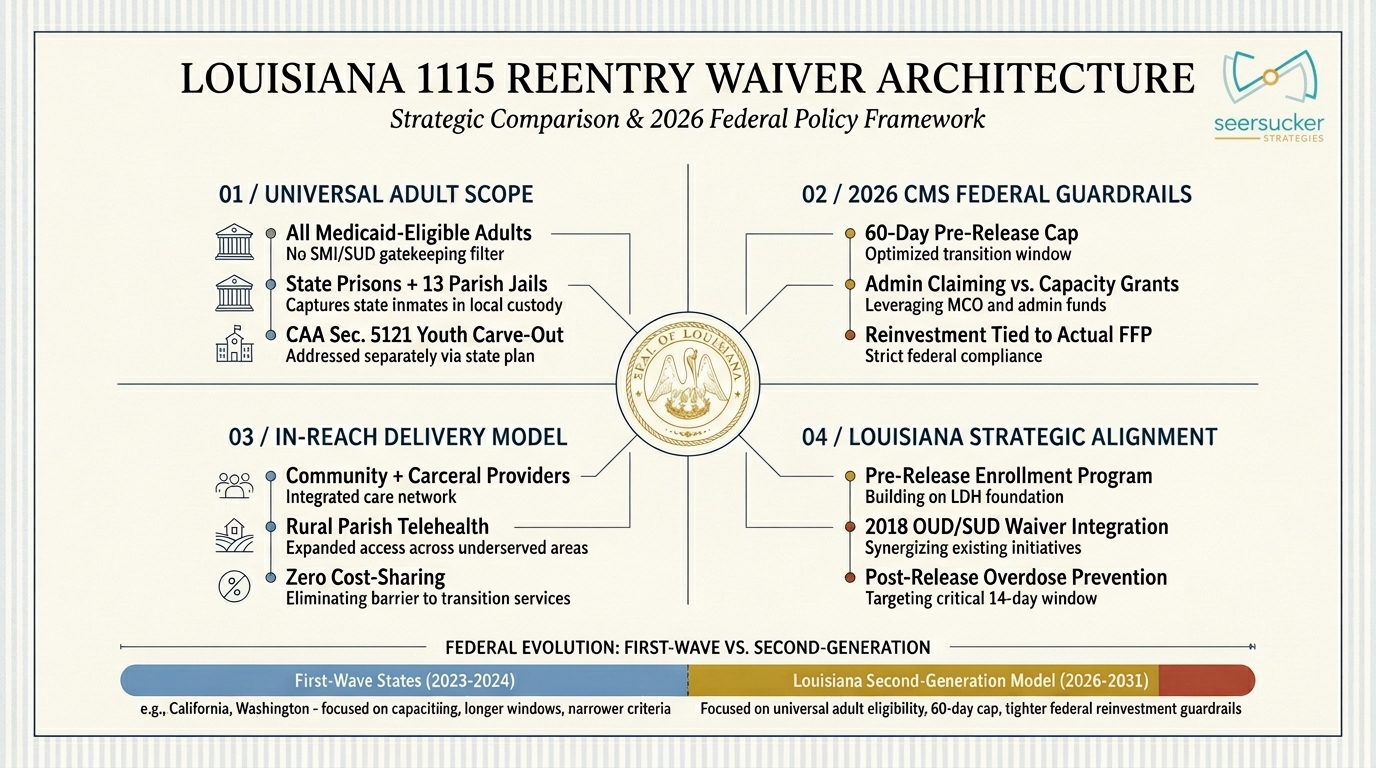
A 60-day cap for adult facilities. Every one of the five asked for 90 days, and every one received 60 for adult settings. CMS pointed to evidence that access to MAT in the 60 days before release reduces overdose risk. It concluded that 60 days is enough to stabilize patients and test whether pre-release services improve transitions. CMS also tied the window to the facility rather than the individual, citing the administrative burden of tracking different windows within one building. Manatt Health has observed that the longer window gave states more lead time to find eligible people and arrange post-release care. In its view, compressing that work into 60 days may be harder in practice.
No start-up money. Earlier approvals commonly included "transitional non-service expenditures" to help correctional facilities build IT, data-sharing, staffing, and workflows. All five September jurisdictions requested this funding, and CMS approved none of it. CMS said it is working with LDH on other administrative claiming routes, such as Implementation Advance Planning Documents.
Reinvestment based on actual federal dollars. Where Medicaid now pays for services a prison or jail previously funded, Louisiana must reinvest an equal amount of the federal match into allowable reentry and justice-related health activities. That obligation will now be recalculated each year from federal funds actually received, with a final reconciliation after the demonstration ends. Reinvested funds may not be used to build or improve correctional facilities.
What comes next
Draft implementation plan to CMSWithin 120 days of approval (late January 2027)
Reinvestment plan and evaluation design to CMSWithin 180 days of approval (late March 2027)
First services at Elayn Hunt Correctional CenterEarly 2027, per LDH
Rapid Cycle Report on early implementationWithin 180 days after claiming begins
Public forum on progressWithin six months of implementation, then annually
The implementation plan is the next document to watch. It will define the service levels, the managed care workflows, and the order in which facilities join. Those details will settle most of the operational questions the approval letter leaves open.
The bigger picture
The demonstration's stated aim is to reduce overdose and death in the period soon after release, a period the state's health system has historically entered only after the fact. Because Louisiana relies on parish jails as well as state prisons, a program that starts treatment before the door opens must reach both kinds of facility to reach the people it is meant to serve. How far that reach extends depends on three things: how many of the 13 eligible parish jails can meet readiness standards without federal start-up support, how well MCOs and community providers link to care inside facilities, and how much of Louisiana's broad eligibility and benefit design survives contact with day-to-day operations. Behavioral health and SUD providers who understand those mechanics now will be positioned to act once the first facilities go live.
Seersucker Strategies will continue tracking the implementation plan and facility rollout for our behavioral health and SUD clients.
Sources: CMS, Louisiana Reentry Demonstration approval letter and Special Terms and Conditions (September 23, 2026); CMS approval letters for the Minnesota Reentry Demonstration and Nevada Reentry Services Demonstration (September 23, 2026), the District of Columbia Whole-Person Care Transformation renewal (September 23, 2026), and Maine's Whole Person Care Waiver (September 25, 2026); CMS, Frequently Asked Questions for Reentry Section 1115 Demonstrations (September 2026); Louisiana Department of Health, Reentry 1115 Demonstration Waiver page and October 2026 announcement; Manatt Health, "CMS Advances Medicaid Reentry With Five New Approvals and Key Policy Changes" (October 1, 2026); Louisiana Illuminator, "Medicaid approves reentry care at Louisiana prisons, jails" (October 12, 2026).