

Health Policy
Year one of rural health transformation: what Alabama, Arkansas and Mississippi funded, and what it signals for Louisiana
Stephen Wright · OCTOBER 1, 2026
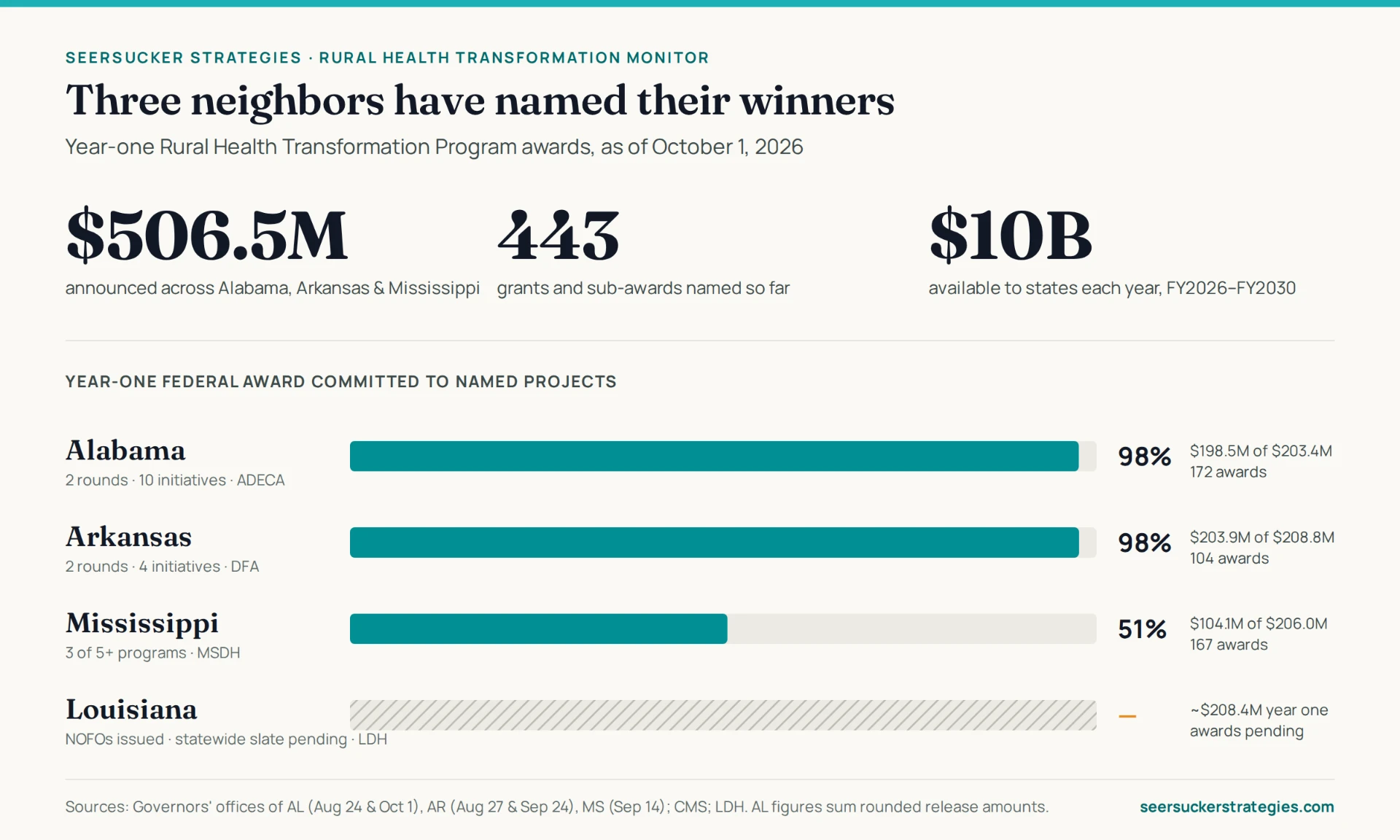
Three of Louisiana's neighbors have named 443 awards worth $506.5 million in federal Rural Health Transformation Program funds. Alabama and Arkansas have now committed nearly all of their year-one awards; Mississippi has committed half. The pattern of who won, and for what, is the clearest preview yet of how Louisiana's $208 million will move.
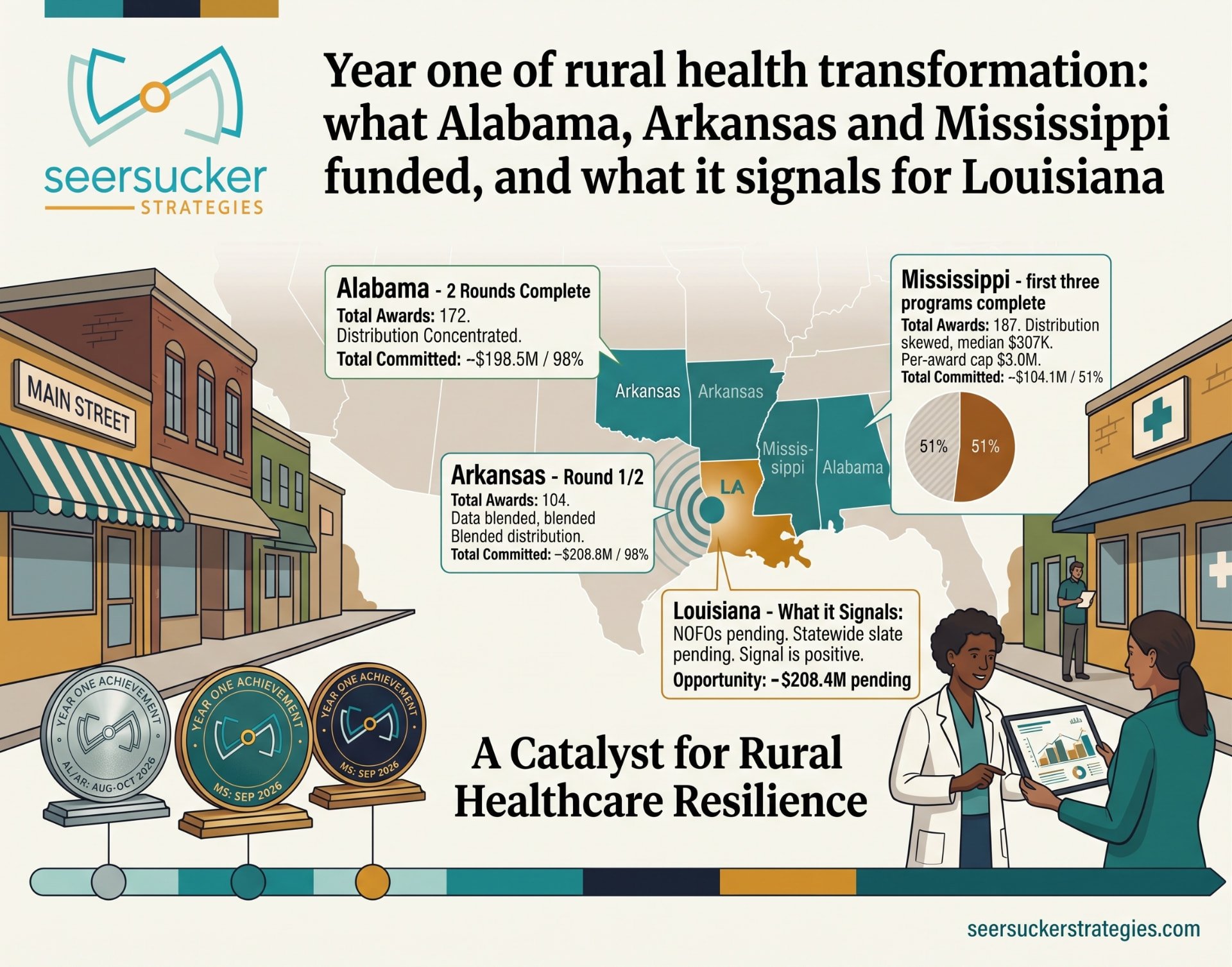
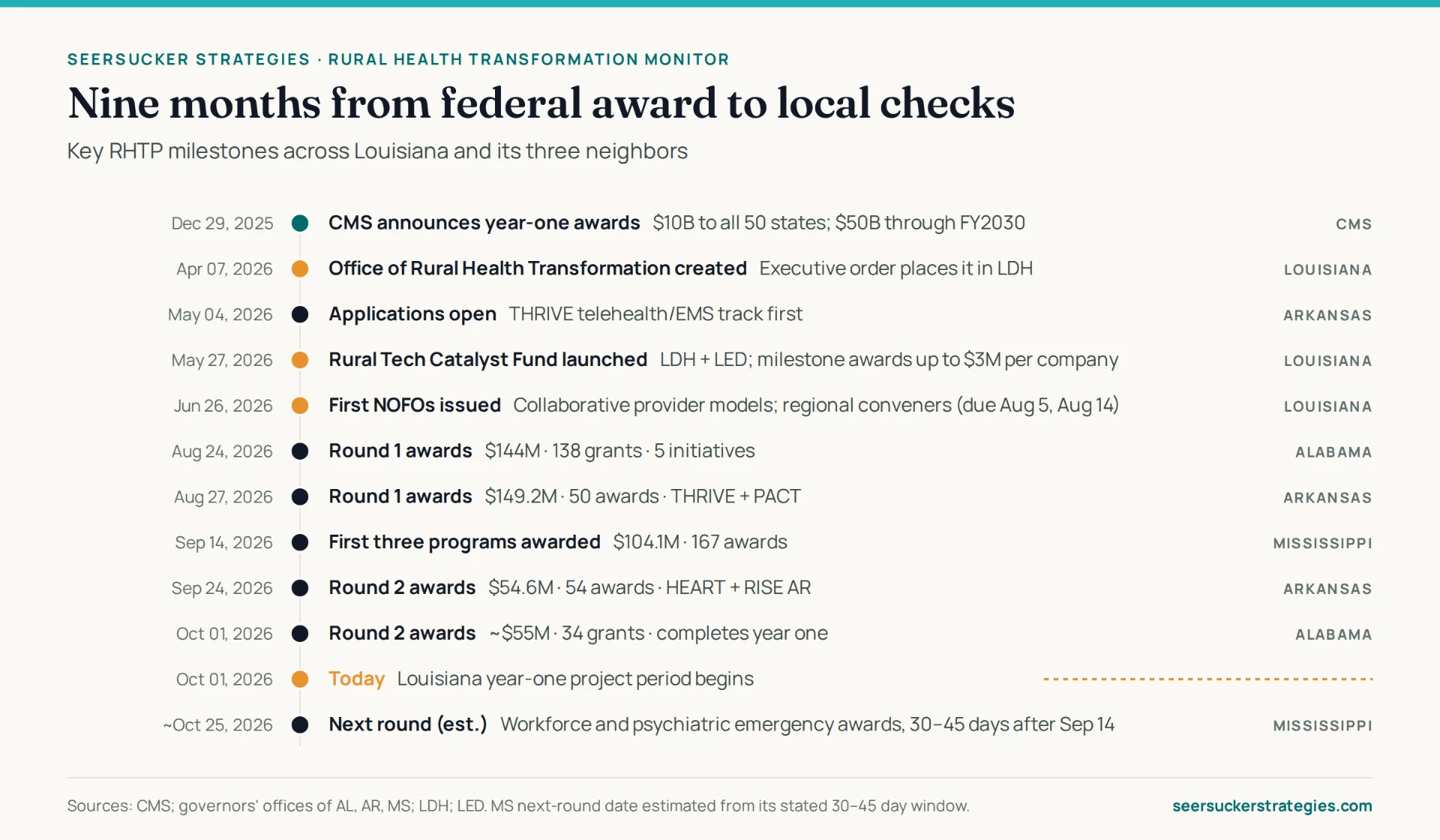
Alabama closed out its first year today. Governor Kay Ivey announced 34 grants totaling nearly $55 million, on top of the 138 grants worth more than $144 million announced August 24. Arkansas finished its year-one distribution September 24 with $54.6 million across 54 projects, following $149.2 million to 50 recipients in late August. Mississippi announced 167 awards worth $104.1 million on September 14, the first three of at least five programs funded from its $205.9 million year-one budget.
Louisiana has not yet published a statewide award slate. Its year-one project period opens today.
The program in brief
Congress created the Rural Health Transformation Program in the 2025 reconciliation law (Public Law 119-21). CMS distributes $10 billion a year to the states from fiscal year 2026 through 2030. Half of each year's money is split evenly among all fifty states; the other half is allocated on rural need, state policy commitments, and CMS's scoring of each state's plan. First-year awards ranged from about $147 million (New Jersey) to $281 million (Texas). Alabama received $203.4 million, Arkansas $208.8 million, Mississippi $206.0 million, and Louisiana roughly $208.4 million.
The federal government sets the frame; the states choose the winners. Each state wrote its own plan, named its own initiatives, and is running its own competitions. That is why three neighbors with nearly identical checks have spent them so differently.
Alabama: workforce pipelines and regional hubs
The Alabama Department of Economic and Community Affairs (ADECA) administers the state's program, which is organized around eleven initiatives. Across both rounds, our tally of the itemized awards comes to 172 grants and about $198.5 million, or 98% of the federal award.
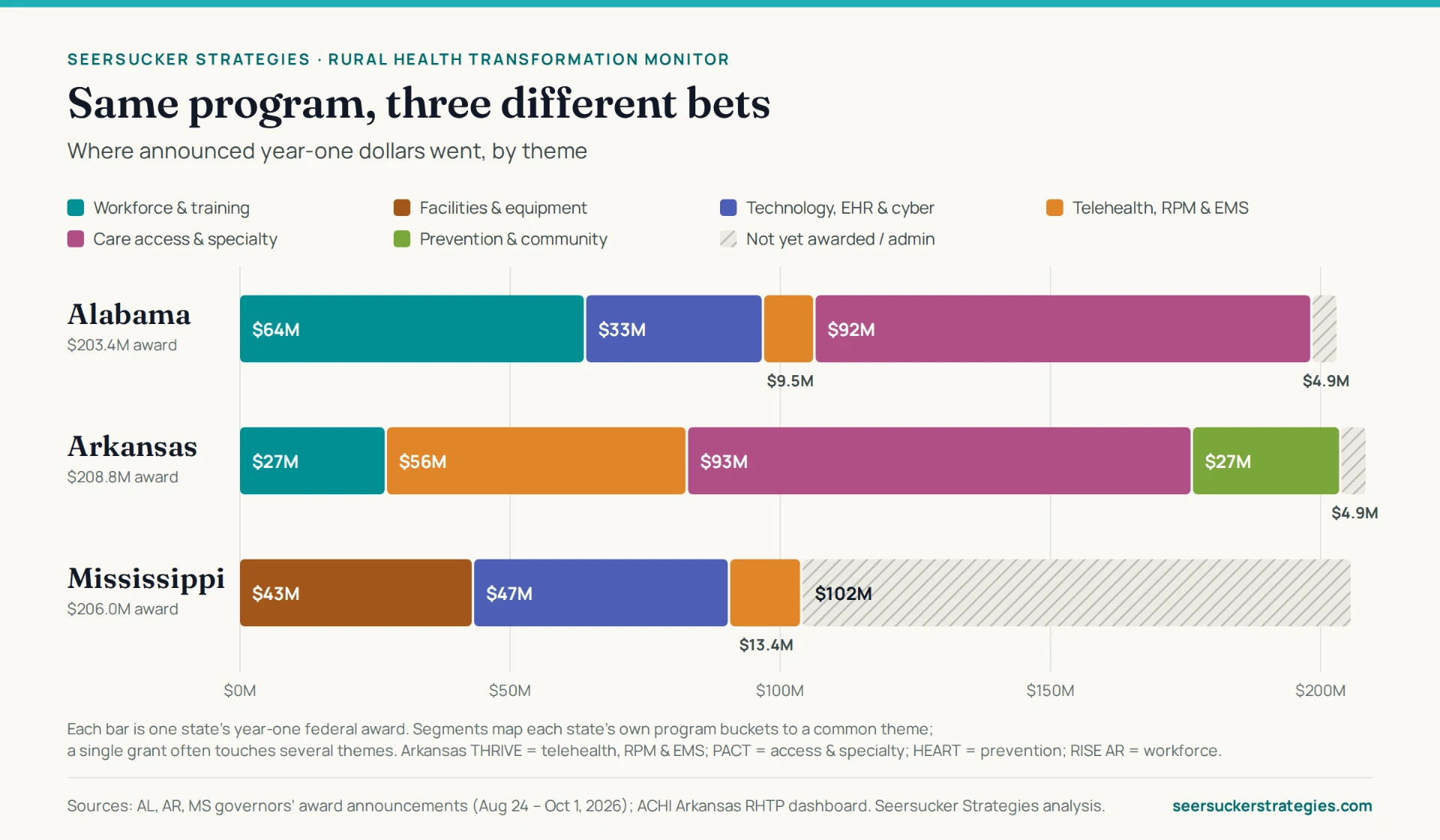
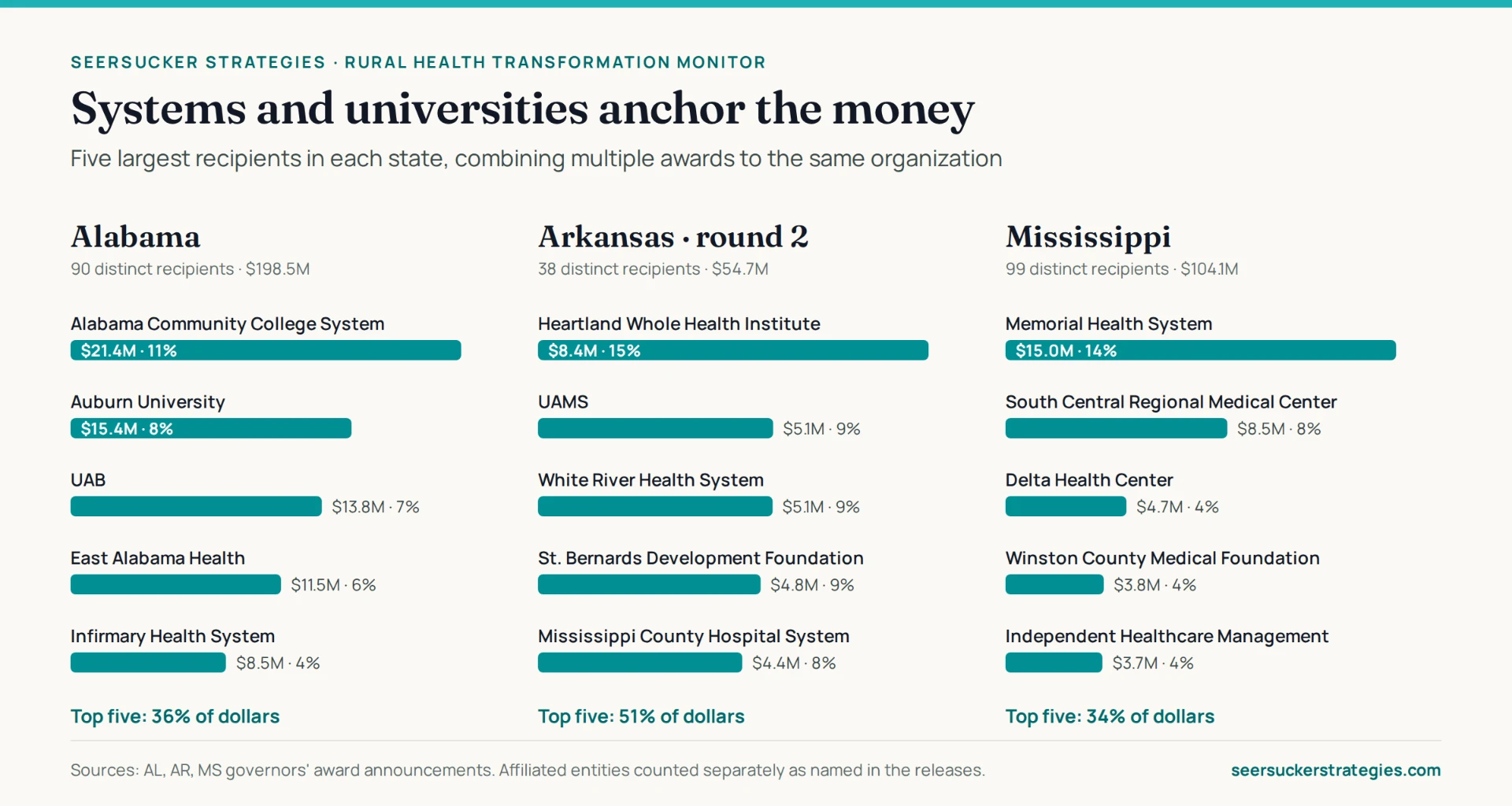
Workforce received the largest single share. The Alabama Community College System won $20.6 million in the second round for a statewide rural pipeline: remote EMT and advanced EMT tracks, shared allied-health curricula in respiratory therapy, surgical technology, radiologic technology and lab science, added nursing faculty, and a structured path to nurse practitioner, physician assistant and nurse-midwife programs. The Alabama School of Healthcare Sciences, a residential high school in Demopolis, received $7.27 million. In round one, UAB received $7 million for its rural primary care physician pipeline, Auburn University $5 million for a Rural Workforce Academy, and three hospital systems received funds to launch new family medicine residencies. Several workforce grants attach a five-year rural service commitment to the incentive.
Technology came early, and in standard sizes. Round one put about $33 million into a Collaborative EHR, IT and Cybersecurity initiative. Five rural hospitals each received exactly $839,753 for IT, cybersecurity and EHR upgrades, a figure that suggests a formula allocation rather than a negotiated award. Auburn ($6.38 million), Infirmary Health ($3.5 million) and Whatley Health Services ($3.49 million) received larger shared-network grants.
Round two opened five new clinical lanes: maternal and fetal health ($7.2 million), EMS treat-in-place ($5.3 million), EMS trauma and stroke coordination ($4.2 million), cancer early detection ($7.8 million), and simulation training ($1.1 million). Most of the maternal grants share a design. The University of South Alabama, Infirmary Health, Flowers Hospital and East Alabama Health each received funds for a hub or access-point network that connects rural patients to maternal-fetal specialists by telehealth and referral. UAB's $1 million equips at least 20 rural hospitals with obstetric emergency carts and simulation training. Eight EMS agencies and systems received treat-in-place grants, which let paramedics assess and treat qualifying patients on scene with physician support rather than transport them to an emergency room.
Behavioral health in Alabama ran through community mental health centers moving to the Certified Community Behavioral Health Clinic model and through school-based services.
Arkansas: four named initiatives and a prevention track
The Arkansas Department of Finance and Administration (DFA) ran four initiatives, each with a fixed budget. Before accepting applications, DFA held ten regional roadshow meetings with EMTs, nurses and hospital leaders. Year one closed at about $203.9 million across 104 awards; the remaining $4.9 million covers contract and administrative costs and a small unawarded balance.
Round one (August 27) funded THRIVE, a telehealth, remote monitoring and emergency response track ($55.7 million), and PACT, a specialty access and clinically integrated network track ($93.5 million). The Arkansas Rural Health Partnership received $18.8 million combined, and UAMS about $12 million across four projects, including stroke, specialty telehealth and maternal care models.
Round two (September 24) split almost evenly between HEART ($27.5 million, 30 projects) and RISE AR ($27.2 million, 24 projects).
HEART is the most distinctive initiative in the region. It funds nutrition, physical activity and chronic disease prevention, and it routes much of that money through community institutions: food banks, Cooperative Extension, Boys & Girls Clubs, a Benedictine abbey, and at least eight church or faith-based partners. The largest HEART award, $8.42 million to the Heartland Whole Health Institute, coordinates providers and pharmacists in 27 counties; Heartland covers its own curriculum and administrative costs. HEART tracks the governor's stated priorities on nutrition, including school breakfast and the state's SNAP waiver on soft drinks and candy.
RISE AR is a physician and clinical pipeline program. New York Institute of Technology's osteopathic college at Arkansas State received $2.89 million for a family medicine residency in Blytheville. Baptist Health and UAMS are building a rural family medicine track in Arkadelphia, with a first class planned for July 2028. St. Bernards received $3.85 million that includes a new psychiatry residency. Mississippi County Hospital System received $4.4 million for a training site and loan-repayment support.
DFA has said project details are not final until it signs an agreement with each grantee.
Mississippi: technology first, at volume
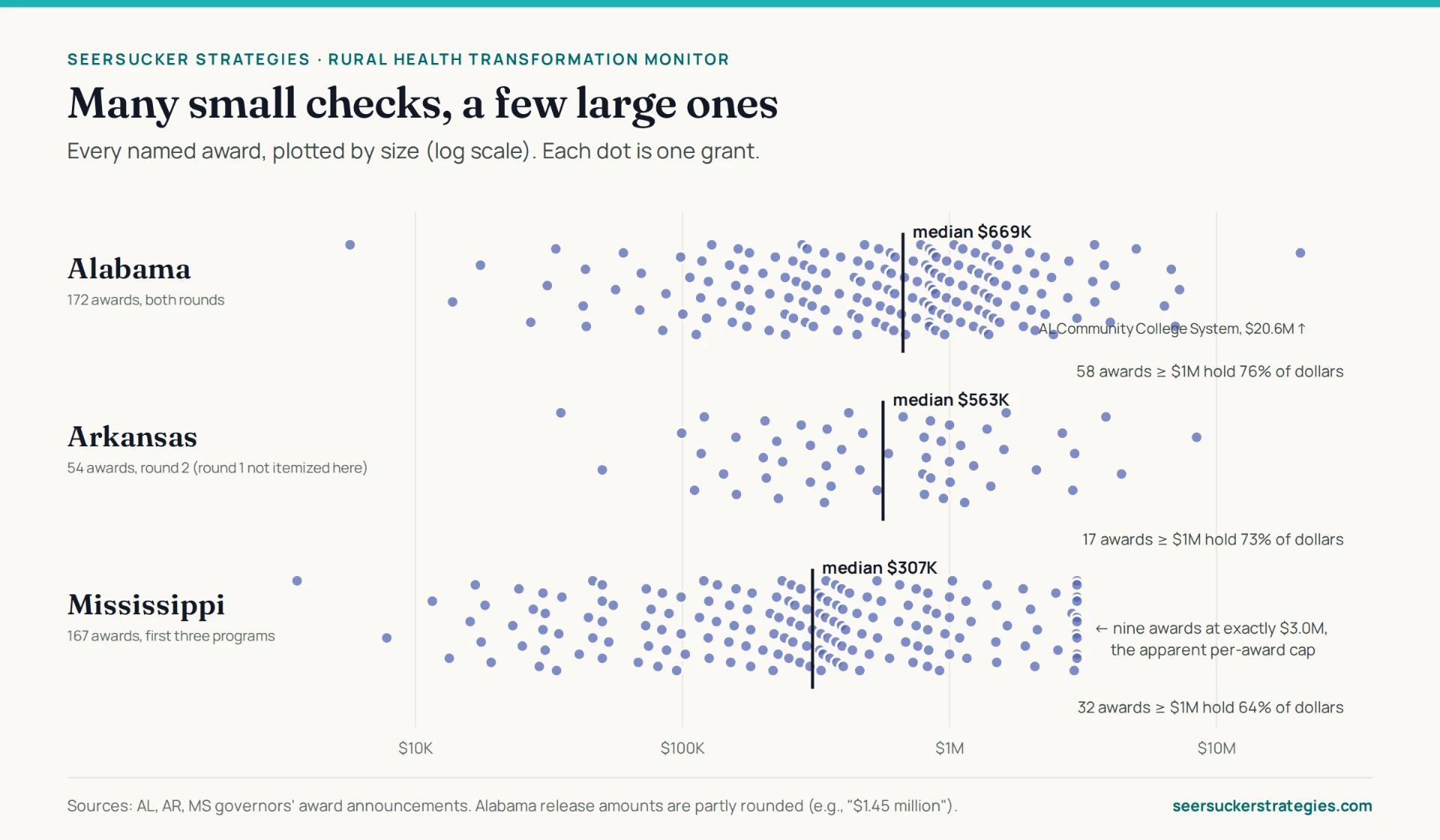
Mississippi's first announcement was the largest by award count and the smallest by median size. Its 167 awards went to 99 organizations in 60 of the state's 82 counties.
Rural Provider TechnologyAwards: 97; Dollars: $47.4M; Median award: $263K
Capital Project Care Gap ClosureAwards: 43; Dollars: $43.3M; Median award: $500K
Telehealth Hub ConnectivityAwards: 27; Dollars: $13.4M; Median award: $256K
TotalAwards: 167; Dollars: $104.1M; Median award: $307K
The technology program reads like a rural hospital IT backlog. Two dozen or more of the 97 technology grants name cybersecurity directly: firewalls, managed detection and response, air-gapped backups, risk assessments and penetration tests. Others replace nurse call systems, retire fax workflows, or upgrade electronic records. Lampton Medical Associates received $2.0 million to modernize records for 50 rural practices to meet new CMS interoperability and prior authorization rules. At least ten awards fund AI tools, including ambient clinical documentation, retinal screening and email threat detection.
The capital program bought equipment and service lines: robotic surgery in Scott and Washington counties, a mobile MRI program, two reopened operating rooms at Tate County Hospital, outpatient imaging, and backup generators. Nine capital and technology awards came in at exactly $3.0 million, which points to a per-award ceiling.
Memorial Health System received the most, $15.0 million across twelve awards. South Central Regional Medical Center received $8.5 million across three.
Mississippi's next steps are announced. Awards for workforce and psychiatric emergency services were under review on September 14 and expected within 30 to 45 days. In October the state will open additional opportunities for innovative care-gap models and for rural EHR modernization.
Five patterns across the three states
1. Workforce money went to institutions with pipelines. The largest workforce awards went to community college systems, universities, and hospitals that already sponsor residencies or training programs. Individual practices won recruitment incentives, usually tied to multi-year rural service commitments.
2. Technology and cybersecurity were treated as the floor. Alabama spent about $33 million on shared EHR, IT and cybersecurity networks; Mississippi spent $47 million on provider technology. Arkansas folded technology into its telehealth and remote monitoring track.
3. EMS is being redesigned. Treat-in-place programs, community paramedics paired with remote monitoring, and regional trauma and stroke transfer networks appear in Alabama and Mississippi awards. These programs anticipate payment models that reimburse treatment without transport.
4. Hub-and-spoke designs won the larger checks. Maternal-fetal medicine hubs, regional shared-services hubs, specialty referral networks and telehealth hubs recur in all three states. A rural hospital applying alone tended to win equipment; a rural hospital applying with a regional system tended to win a program.
5. Many small checks, a few large ones. Median awards ran from $307,000 in Mississippi to about $669,000 in Alabama. In every state, awards of $1 million or more accounted for roughly two-thirds to three-quarters of the dollars.
What year one tells us about future awards
The first year's awards follow from the program's design, and the design does not change in year two. Several conclusions follow.
CMS has said it will use the same general allocation approach in later years, and part of each state's allocation depends on policy commitments and the scoring of its plan. States therefore have an incentive to show measurable progress on the initiatives they already funded. Year-two dollars are more likely to extend year-one networks than to start unrelated ones.
States must also spend each year's funds by the end of the following fiscal year, and CMS can redistribute what goes unspent. Administrators will favor applicants that can show they are ready to start, with a signed partner, a site, staff and a budget, over promising concepts that need a year of planning.
The award structures repeated across the region: standardized hospital IT grants, per-award ceilings, multi-year service commitments, required sustainability plans. These are features of a state administrator trying to move a large sum quickly with few staff. Applicants should expect them again and plan budgets around them.
Governor Sanders told the August audience that the PACT and THRIVE awards are not blank checks, and Louisiana's own NOFO requires quarterly and annual reports with measurable outcomes. The organizations that win year two and beyond will be those that can report results from year one.
What it means for Louisiana
Louisiana's program sits in the Louisiana Department of Health's Office of Rural Health Transformation and Sustainability, created by executive order on April 7. LDH has issued notices of funding opportunity for collaborative provider models (awards of $10,000 to $500,000, applications due August 5) and regional care conveners and navigation networks (due August 14). With Louisiana Economic Development, it launched a Rural Tech Catalyst Fund in May, offering milestone-based awards of up to $3 million per company. UL Lafayette has received nearly $2.1 million for rural nursing and health AI work. LDH has said it will publish awards and parish-level priorities on a public portal.
For Louisiana providers and associations, the neighboring states' first year suggests five practical steps:
Find the regional partner now. Hub-and-spoke applications won the larger awards in all three states.
Fix the technology floor. A current cybersecurity assessment and an EHR plan are the prerequisites for care-model funding.
Bring a workforce commitment with terms. Service obligations, retention bonuses and residency or training affiliations were common features of funded workforce proposals.
Show sustainability. Arkansas's Heartland award paid its own administrative costs; that kind of cost-sharing reads well to administrators.
Prepare to report. Year-two competitions will ask what year-one money produced.
AlabamaYear-one federal award: $203.4M; Announced to date: ~$198.5M; Awards: 172; Status (Oct 1, 2026): Year one complete (2 rounds)
ArkansasYear-one federal award: $208.8M; Announced to date: $203.9M; Awards: 104; Status (Oct 1, 2026): Year one complete (2 rounds)
MississippiYear-one federal award: $206.0M; Announced to date: $104.1M; Awards: 167; Status (Oct 1, 2026): 3 programs awarded; workforce and psychiatric emergency pending
LouisianaYear-one federal award: ~$208.4M; Announced to date: Not yet published; Awards: n/a; Status (Oct 1, 2026): NOFOs issued; year-one project period opens Oct 1
From Baton Rouge to your boardroom
When three states with nearly identical federal checks choose such different priorities, and when each of those choices rewards applicants who were ready before the money arrived, the lesson for Louisiana is about timing as much as substance. The first round is rarely the last, and the organizations that study the neighbors' awards now will write stronger applications when Louisiana's competitions open again.
Seersucker Strategies tracks RHTP funding opportunities and awards across the Gulf South for healthcare providers and associations.
Sources: Office of the Governor of Alabama (August 24 and October 1, 2026 releases); Office of the Governor of Arkansas (August 27 and September 24, 2026 releases); Office of Governor Tate Reeves (September 14, 2026 release); Arkansas Democrat-Gazette (August 27, 2026); Arkansas Center for Health Improvement, Arkansas RHTP Year 1 Awards dashboard (September 2026); Centers for Medicare & Medicaid Services; KFF, "A Closer Look at the $50 Billion Rural Health Transformation Program"; Louisiana Department of Health (December 29, 2025 and April 7, 2026 announcements; Collaborative Provider Models NOFO, June 26, 2026); Louisiana Economic Development; University of Louisiana at Lafayette. Award totals, medians and theme groupings are Seersucker Strategies calculations from the itemized releases; Alabama figures sum amounts that the releases partly round.